Tourist Visa for Self-Employed Indians: Documents Guide
You run your own business, work with clients or earn through freelance projects. Now you are planning a holiday abroad, and the visa checklist asks for salary slips and an employer letter. What should you submit when you do not have either?
A tourist visa for self-employed Indians requires a different way of explaining work and income, not a different story. Relevant documents can include business registration records, recent invoices, client agreements, tax returns and bank statements, depending on the destination’s requirements. For example, the UK’s official visitor guidance recognises business registration documents or recent invoices as evidence of ongoing self-employment.
The key is consistency: your occupation, financial records and travel plans should support the same explanation.
This guide helps Indian freelancers, consultants, business owners and independent professionals organise their documents for a tourist or visitor visa. It is a preparation guide, not a universal checklist. Always follow the official requirements for your destination.
Can self-employed Indians apply for a tourist visa?
Yes. Being self-employed does not automatically prevent you from qualifying for a tourist visa. The UK, for example, explicitly provides for evidence of ongoing self-employment in its visitor-document guidance. Applicants must still demonstrate that they are genuine visitors, can afford the visit and intend to leave at the end of their stay.
The practical difference is how you explain your circumstances. Instead of relying on an employer’s confirmation and monthly payslips, you may need records that establish:
- What work or business you do.
- Whether that activity is ongoing.
- Where your travel funds come from.
- How the trip fits your personal and professional circumstances.
Think of the application as an explanation supported by evidence, not a competition to upload the largest number of documents.
Documents for a tourist visa for self-employed Indians
Start with the destination’s official checklist. Then identify which documents accurately explain your work, income and proposed holiday.
The table below is an organising framework. Not every document applies to every applicant, and these are not universally mandatory requirements.
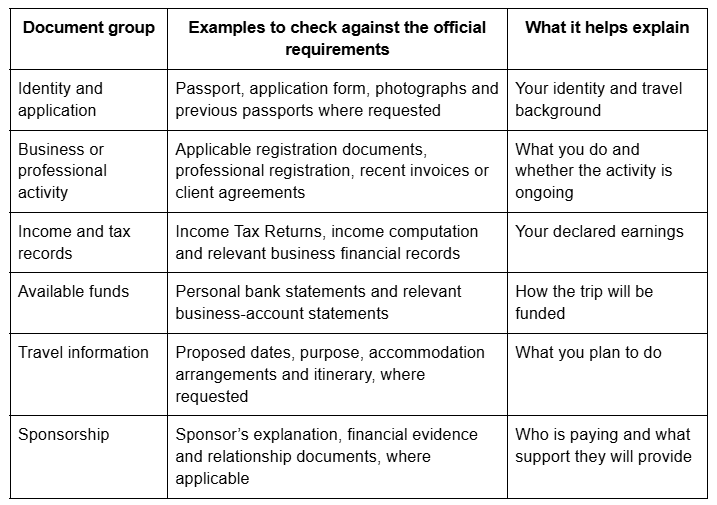
Official UK guidance, for instance, asks for financial evidence showing access to funds and their origin, alongside information about the applicant’s circumstances. Its examples should not be treated as the checklist for another country.
How to explain your self-employment
Describe your occupation accurately on the application form. “Self-employed” identifies your working arrangement, but it may not fully explain your profession.
A brief, specific description is more useful:
- “Self-employed graphic designer working with Indian clients.”
- “Sole proprietor of a retail clothing business.”
- “Independent marketing consultant.”
- “Partner in an accounting firm.”
Use the same description across your application, supporting explanation and relevant records. If you trade under a business name, explain how it relates to you.
If you own a business
Identify the genuine records that establish your role and business activity. Depending on your structure, these might include an applicable registration certificate, partnership deed, incorporation record or evidence of directorship.
Pair evidence of the business’s existence with evidence of current activity. A registration certificate explains when an entity was established; recent invoices or transactions can help explain whether it is operating. UK visitor guidance specifically recognises registration documents or recent invoices as evidence of ongoing self-employment.
Do not assume that every business owner needs GST registration, Udyam registration and incorporation documents. Select records that actually apply to your business and the destination’s instructions.
If you are a freelancer or consultant
Your work may be documented through client agreements, invoices and payments rather than a company registration certificate.
Where relevant and accepted, organise records that connect:
- The service you provide.
- The client engagement.
- The invoice or payment request.
- The corresponding payment received.
For example, a designer could use a recent client agreement, an invoice and the matching bank credit to explain an engagement. This is an illustrative way to organise evidence, not a substitute for a destination’s official requirements.
A website or portfolio may provide context, but do not rely on it alone to explain income.
Financial proof: explain where the money comes from
Your financial documents should make it understandable how you earn and how you will pay for the holiday.
The UK’s official guidance specifically asks for financial documents showing sufficient available funds and access to those funds. Bank statements should detail the origin of the money held.
For a self-employed applicant, useful questions to work through are:
- Which account receives your professional or business income?
- Which account holds the money available for the trip?
- Are transfers between those accounts understandable?
- Does your planned spending fit the funds you can genuinely access?
Personal and business bank statements
Personal and business accounts explain different things.
Your personal statement may show savings available for travel. A business-account statement may help explain trading activity, but the balance should not automatically be presented as money personally available for your holiday.
If you transfer income from your business to your personal account, make that relationship clear. Do not describe business turnover as personal take-home income.
Submit the statement period and format requested by the destination rather than assuming that every country needs the same number of months.
Irregular income and large deposits
Freelance payments do not always arrive on the same date each month. Explain the pattern accurately instead of trying to make it look like salaried employment.
If a significant credit needs context, identify its genuine source and retain supporting evidence. It might be a client payment, investment redemption or transfer between your own accounts.
The aim is not to avoid every unusual transaction. It is to make the source and availability of funds understandable, consistent with the official UK guidance on financial evidence.
Is there a fixed minimum bank balance?
Do not use a single balance figure as a rule for every destination.
Check whether the country publishes a financial threshold or requires particular evidence. Where it does, follow that requirement. The UK visitor-document guidance, for example, focuses on sufficient accessible funds for the visit rather than giving one universal balance for all applicants.
How to explain your reasons to return to India
A temporary holiday should make sense alongside your ongoing life in India.
For UK visitors, leaving at the end of the visit is an explicit requirement, and official guidance recommends providing information about circumstances in the applicant’s home country.
As a preparation exercise, identify the genuine circumstances relevant to your application:
- An active business or professional practice.
- Ongoing client engagements.
- Responsibilities that continue after the holiday.
- Relevant family or household circumstances.
- Other commitments that help explain your planned return.
Only submit evidence that is relevant and requested or permitted. No single property document, client contract or family record guarantees approval.
Should you include a cover letter?
If the destination requests or allows a cover letter, use it to clarify your circumstances, not to repeat every attachment.
A concise explanation can cover:
- Your occupation and business or professional background.
- The purpose and proposed dates of the holiday.
- Who will pay for it?
- How your supporting documents explain your income.
- Any transaction or circumstance needing brief clarification.
- Your plans to return to India.
Here is an illustrative opening:
I am a self-employed marketing consultant based in New Delhi. I am applying to visit [destination] for tourism from [date] to [date]. I will fund the trip from my personal savings. The attached records explain my ongoing client work, income and funds available for the visit.
Adapt this to your real circumstances. Do not copy statements that your documents cannot support.
What if someone else is paying for your trip?
Separate your employment situation from your funding arrangements. You can explain your self-employment while also making clear that another person is paying for some or all of the holiday.
Check the destination’s sponsorship requirements. For the UK, supporting evidence should explain:
- What support the sponsor is providing.
- How they will provide it.
- Whether they can afford to support themselves and their dependents.
- Their relationship with the applicant.
- Their lawful UK status, where applicable.
Avoid vague wording such as “family sponsored” without explaining who is paying and what costs they will cover.
Travel plans and bookings: follow the destination’s instructions
Do not assume every visa application requires paid flights and hotel bookings.
Some destinations request reservations or accommodation evidence; others assess different supporting information. The UK’s visitor guidance, for example, lists hotel bookings and flight bookings, except for transit, as less useful evidence. It also warns that submitting documents does not guarantee approval and advises applicants to consider this when making bookings.
Keep your dates, purpose and proposed arrangements consistent, but check the official instructions before spending money on non-refundable bookings.
Common mistakes to avoid
Use the following as a final review checklist:
- Describing yourself as salaried when you are self-employed.
- Giving different occupation details across the form and supporting explanation.
- Submitting business records without explaining your connection to the business.
- Treating turnover as personal income.
- Leaving major transfers or funding arrangements unclear.
- Presenting a sponsor’s money as your own savings.
- Uploading every available document without checking its relevance.
- Using altered statements, fabricated invoices or inaccurate claims.
- Assuming a general online checklist overrides official instructions.
Also distinguish your occupation from your travel purpose. Being self-employed in India does not, by itself, mean the holiday should be described as a business trip. If you intend to undertake work or professional activities abroad, check the permitted activities and appropriate visa route before applying.
Final checklist before submitting
Before submitting your tourist-visa application:
- Check the official destination-specific requirements.
- Confirm that your name, passport details and dates match throughout.
- Describe your occupation accurately.
- Select genuine evidence of ongoing work.
- Make the source and availability of your travel funds clear.
- Explain sponsorship where applicable.
- Check any translation requirements.
- Remove irrelevant or duplicate attachments.
- Review the application against the trip you actually intend to take.
For UK applications, documents not in English or Welsh must have a full translation that meets the published requirements. Other destinations may have different language and translation rules.
Frequently asked questions
Can I apply for a tourist visa without salary slips?
Self-employed applicants may be able to use other evidence of their work and finances. UK visitor guidance, for example, recognises business registration documents or recent invoices as evidence of ongoing self-employment, alongside financial documents showing available funds. The exact requirements depend on the destination.
Is GST registration compulsory for a tourist visa?
Do not treat GST registration as a universal tourist-visa requirement. Check the destination’s checklist and provide documents relevant to your actual circumstances. The UK guidance gives business registration documents or recent invoices as examples; it does not prescribe an Indian GST certificate for every self-employed applicant.
Can a freelancer apply without a registered company?
UK visitor guidance allows recent invoices as one example of evidence of ongoing self-employment, rather than prescribing company registration as the only option. Other destinations may require different evidence, so check their official instructions before applying.
Does submitting all the documents guarantee approval?
No. The UK’s official guidance explicitly states that submitting the listed documents does not guarantee a successful application or entry at the border. Supporting documents help explain your circumstances; they do not replace the eligibility requirements.
Plan your application with Visafir
Preparing a tourist visa for self-employed Indians starts with making the work, finances and holiday plan easy to understand.
For guidance on organising your visitor-visa application, contact Visafir with your destination, proposed dates and work profile. Always check the official checklist before submission, and remember that the final decision rests with the relevant immigration authority.
Be the first to comment.